Overview of Arts & Solidarity Project
Actions in 2026: Research/ Laboratory/ Local Workshop
Collaborating Partner:
Femlink, Vienna
Supported by:
Erasmus+ programme
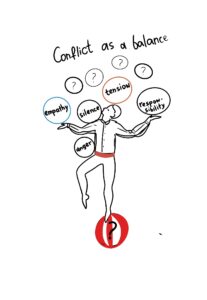 Live Illustration by Ziliä Qansurá
The Arts & Solidarity research explored conflict transformation through feminist artistic practices and peaceful mediation approaches. It included a literature review and five focus groups involving over 35 participants engaged in adult learning. The literature review examined conflict dynamics in adult learning, community, organisational, and social contexts, highlighting the potential of creative, arts-based methodologies in mediation training. The focus groups brought together professionals from arts, academia, and community practice to explore peace-building through interdisciplinary dialogue and participatory methods. These sessions encouraged critical reflection on conflict, recognising its potential to foster creativity, dialogue, social transformation, and stronger community relationships.
The research clearly demonstrated that in considering adult learning and community work contexts, it is important to consider the way group cultures are shaped and how sets of shared patterns, behaviours, values, and assumptions evolve over time. The operational culture and atmosphere of a group is shaped by the type of language they use and the rituals they form. Through the interaction of the group over time a set of values, methodologies and philosophies also evolve that allow for a clearer framing of what the group stands for. Such more public facing aspects of group identities and cultures are nevertheless guided by more implicit group norms that are embedded in the shared meanings they create, how they perceive identity, how they handle different skills sets and viewpoints and how they develop despite difference, common ways of thinking and common practices (Schein, pp.20-21).
The way in which leadership is managed and institutional culture is formed depends on the type of policies, power structures and communication patterns groups set in place, particularly in organisations that operate within the third sector, where a lot of adult learning processes happen and where also a substantial amount of cultural production takes place (Kallman & Clark, 2016). When we consider processes of community working and adult learning, conflicts might arise because of grassroots tensions due to divergent viewpoints on horizontality and decision making. Cultural differences, lived trauma, feelings of marginalization, scarcity of resources, social inequalities within the group, language and issues of identity can all contribute in such settings. Lawrence Mann in mapping readings regarding community organization practices points out that decision making is a result not of “individual choices but from a flow of choices. … A series of acts are involved in a decision to take or not to take a particular public action” (1969, p.71). Writing on conflict and collaborative learning processes Azusa Nakata et al. point to the fact that whilst conflict can in fact contribute to cognitive development it can also give rise to negative emotions as situations of argumentation impede collaborative processes causing tension and thereby hindering cognitive development. Such contexts of conflict can affect focus, processing of information and dialogue engagement (2025, p.292).
The research was backed up by the discussions that took place within the focus groups, which addressed structural and organizational dimensions of conflict, with particular attention to workplace environments in the cultural and educational sectors. Issues such as hierarchy, leadership styles, cultural differences, and unclear communication were identified as common triggers for conflict escalation. Participants reflected on the links between unresolved conflict, stress, and burnout, noting that avoidance often leads to accumulation of tensions and eventual breakdowns in collaboration. In response, the importance of early detection, ongoing dialogue, and investment in relationship-building was emphasized as key to sustainable conflict management.
21–26 June 2026 | Celadon
Between 21 and 26 June 2026, Celadon hosted the Conflict Mediation Lab, a five-day programme bringing together Austria- and Cyprus-based trainers, educators, artists, and facilitators to explore arts-based approaches to conflict mediation.
Organised within the framework of the Arts & Solidarity project, the lab focused on understanding conflict dynamics, navigating disagreements, and developing creative strategies for mediation in educational, organisational, and community settings.
Through participatory workshops, artistic exercises, and collaborative discussions, participants explored how creative practices could support active listening, empathy, constructive dialogue, and the expression of different perspectives. The sessions examined the role of the mediator in facilitating communication, addressing tensions, and creating inclusive spaces for conflict resolution and transformation.
Drawing on their professional experiences, participants exchanged mediation practices, tested artistic tools, and reflected on how conflict could be approached as an opportunity for mutual understanding, learning, and social change.
The lab strengthened participants’ conflict mediation and facilitation skills while fostering intercultural exchange between practitioners based in Austria and Cyprus. It also contributed to the development of practical, transferable arts-based methodologies for addressing conflict and promoting peaceful communication within adult learning and community contexts.
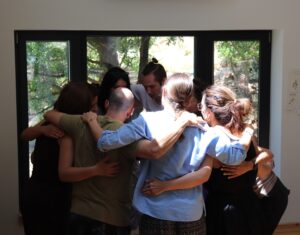
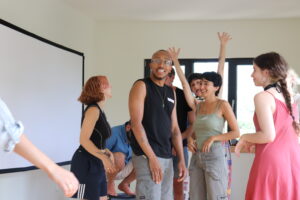
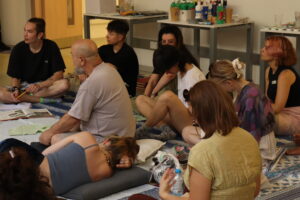
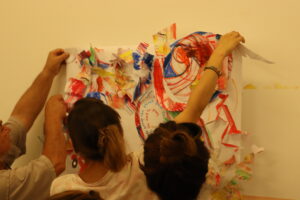
Photographs by Elina Melnikova
It’s not you, it’s not me, it’s us: A workshop on learning to mediate conflict by working together through art methodologies.
Arts & Solidarity Project, Celadon Center for Arts & Ecologies
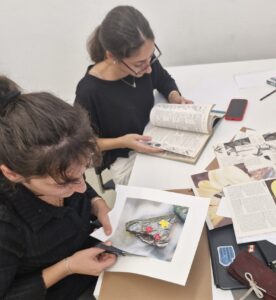
This 3-hour workshop is designed for artists, trainers, educators, students and facilitators interested in exploring how creative and artistic methods can support conflict mediation and transformation. The workshop introduces participatory approaches that use artistic expression to foster conflict mediation skills such as communication, empathy, dialogue, and collaborative problem-solving.
Through interactive activities and guided reflection, participants explore how creative practices can help address conflict, encourage different perspectives, and create inclusive spaces for meaningful exchange. The workshop offers an introduction to practical tools and methodologies that can be adapted to formal and non-formal education, adult learning, creative collective practices, community work, and intercultural contexts.
Objectives
Learning Outcomes.
By the end of the workshop participants should be able to:
Content
Introductions and check in process. Disclaimer that the session might trigger sensitive issues for some of the participants. (15 minutes)
Presentation on what is conflict mediation (drawn from the Arts & Solidarity Literature Review and the Focus Groups) with specific examples from adult learning contexts. (15 minutes)
Staged argument by leader and spect-actor (using theatre of the Oppressed Methodologies) around a subject matter that feels relevant to the leader and group context, for example Gender Identification (15 minutes)
Reflection with the Group (20 minutes)
Break (15 minutes)
Participants are asked to write a 200-300 word text on how the staged argument could be mediated between the workshop leader and the spect-actor. Participants choose one sentence from the text to share within the group and to act as inspiration for a collage. (30 minutes)
Short Presentation on collage making techniques (5 minutes) followed by the creation of a collage using printed matter easily available. (35 minutes)
Pin all participant collages to the wall. Each participant shares orally one sentence from their text while their collage is filmed with a mobile device. All the clips of the participants’ collage and audio are combined via the use of a mobile application into one video which is shared with the participants at the end of the session. (15 minutes)
See an example here created on 26/10/2026: https://drive.google.com/drive/folders/1ybFb8z_3iwG7FP2F6IzrsVGJ9ULy9Vxe
Closing and check out process (15 minutes)
Materials needed for instructor: The Arts & Solidarity Literature Review, A spect-actor, Printed Matter for Collage (for example newspapers, magazines, flyers), Scissors (One per participant), Glue, A3 Paper, Masking Tape, Mobile Device for capturing video and editing them all together.
Indicative Bibliography
Mann, L. D. (1969). Studies in community decision-making. In R. M. Kramer & H. Specht (Eds.), Readings in community organization practice. Englewood Cliffs: Prentice-Hall, pp. 62–75.
Nakata, A. Vuopala, E. & Weinberge, A. (2025). “Conflict experiences and management strategies in intercultural collaborative learning” in Research in Comparative & International Education. 20(2), p.p. 291–313, SAGE.
Piepmeier, A. (2008). “Why Zines Matter: Materiality and the Creation of Embodied Community” in American Periodicals A Journal of History & Criticism, 18(2), p.p. 213-238.
Rahim, M. A. (2001) Managing Conflict in Organizations Third Edition, Westbrook & London: Quorum Books.
Schein, E. H. with Schein P. (2017). Organizational Culture and Leadership 5th edition, Hoboken: Wiley.
“Funded by the European Union. Views and opinions expressed are however those of the author(s) only and do not necessarily reflect those of the European Union or OeAD-GmbH. Neither the European Union nor the granting authority can be held responsible for them.”